Skip to content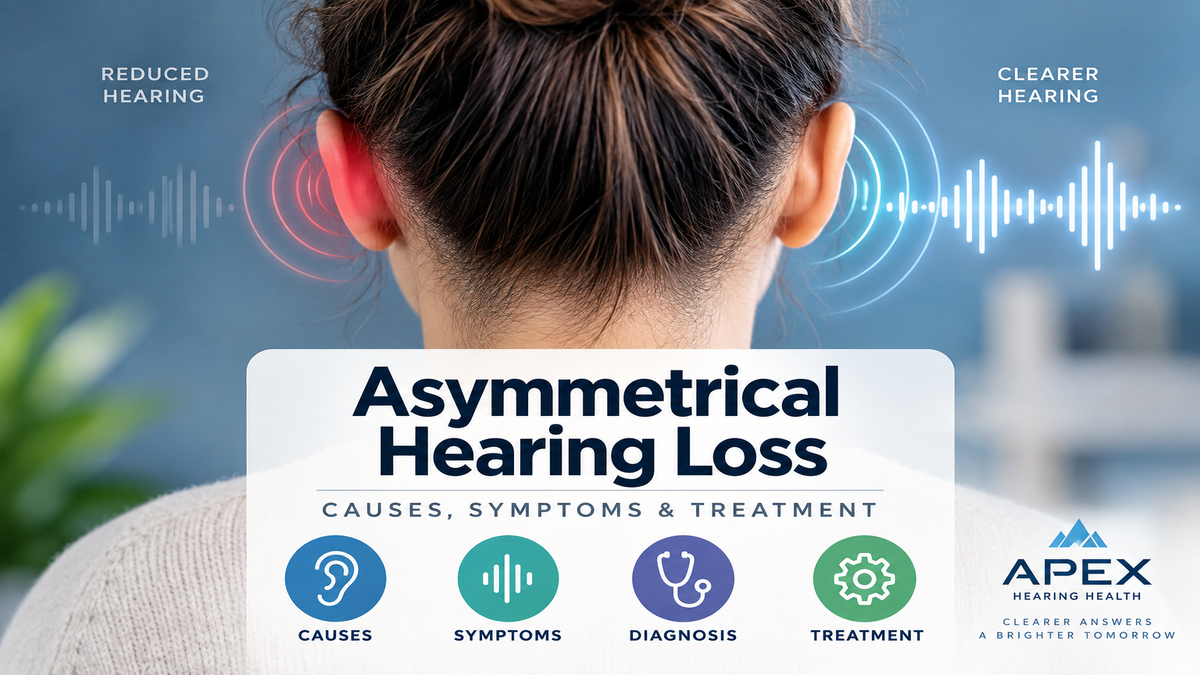
About This Article
Written by: Apex Brain & Hearing Health Editorial Team
Developed using reputable medical literature, clinical guidance, and trusted health organizations whenever appropriate.
Affiliate Disclosure: Apex Brain & Hearing Health may earn a commission if you purchase through links on this page, at no additional cost to you. As an Amazon Associate, we earn from qualifying purchases. Learn more.
- Asymmetrical hearing loss means hearing differs meaningfully between the two ears. There is no single universal audiometric definition; clinicians consider the size and pattern of the difference along with symptoms and medical history.
- Possible causes range from relatively common ear problems to conditions that need medical investigation. These can include earwax, middle-ear disorders, noise exposure, Ménière’s disease, sudden sensorineural hearing loss, and, less commonly, vestibular schwannoma or other retrocochlear disorders.
- A new or unexplained difference between the ears deserves professional evaluation. Depending on the findings, an audiologist or physician may recommend additional testing or referral to an ear, nose, and throat specialist.
- Sudden hearing loss in one ear should be evaluated promptly. Sudden sensorineural hearing loss is time-sensitive and should not be assumed to be earwax, congestion, or a routine ear infection.
- Treatment depends on the cause and the amount of usable hearing in each ear. Options may include medical treatment, conventional hearing aids, CROS or BiCROS systems, bone-conduction technology, or cochlear implantation for appropriately selected people.
Hearing is rarely identical between the two ears. Small differences can occur without causing a meaningful problem.
A larger or unexpected difference is different.
Asymmetrical hearing loss describes a situation in which hearing sensitivity or hearing performance differs significantly between the ears. The difference may be mild or substantial, gradual or sudden, and temporary or permanent depending on the underlying cause.
Because certain medical conditions can initially appear as one-sided or asymmetrical hearing loss, an unexplained difference between the ears deserves appropriate evaluation rather than being dismissed as a normal part of aging.
What Is Asymmetrical Hearing Loss?
During a hearing evaluation, an audiologist measures hearing thresholds at multiple frequencies and compares the results between the ears.
There is no single definition of asymmetrical hearing loss that is used in every clinical setting. Different referral and research criteria use different combinations of:
- The number of decibels separating the ears
- The frequencies at which the difference occurs
- Whether the difference appears at one frequency or several adjacent frequencies
- Differences in speech-recognition performance
- Associated symptoms and medical findings
For example, some clinical criteria consider differences of approximately 15 dB or more at certain frequencies important enough to investigate, while other protocols use different thresholds or combinations of frequencies.
That is why an audiogram should be interpreted as a complete pattern rather than by applying a single number to every person.
Why Hearing With Two Ears Matters
Two-ear hearing provides information that helps the auditory system determine where sounds originate and understand speech when competing sounds are present.
When hearing is substantially poorer in one ear, a person may notice problems such as:
- Difficulty determining where a sound is coming from
- More difficulty understanding conversation in background noise
- Missing speech coming from the poorer-hearing side
- Needing to position the better ear toward a speaker
- Greater listening effort in group conversations
The effect varies considerably. Someone with a small difference between ears may notice very little difficulty, while someone with severe hearing loss in one ear may experience substantial problems with localization and speech understanding in noise.
Asymmetrical Hearing Loss vs. Unilateral Hearing Loss
The terms are related but are not always interchangeable.
Unilateral hearing loss generally means hearing loss affecting one ear while hearing in the other ear is substantially better or within the normal range.
Asymmetrical hearing loss is broader. Both ears can have hearing loss, but one ear performs meaningfully worse than the other.
For example, a person could have mild hearing loss in the right ear and moderately severe hearing loss in the left ear. That would represent an asymmetrical pattern even though neither ear has completely normal hearing.
Is Asymmetrical Hearing Loss the Same as Single-Sided Deafness?
No.
Single-sided deafness (SSD) describes severe-to-profound sensorineural hearing loss in one ear with normal or near-normal hearing in the other ear.
SSD can therefore be considered one particular form of highly asymmetric hearing, but many people with asymmetrical hearing loss do not have single-sided deafness.
This distinction matters because management options depend on how much usable hearing remains in each ear.
What Causes Asymmetrical Hearing Loss?
Many conditions can produce unequal hearing between the ears. Some affect the outer or middle ear, while others involve the inner ear, auditory nerve, or related structures.
Possible causes include:
- Earwax blockage: Impacted cerumen can reduce hearing more in one ear than the other.
- Middle-ear fluid or infection: Problems affecting sound transmission through one middle ear can create a conductive difference between the ears.
- Eardrum or middle-ear disorders: Structural abnormalities, chronic ear disease, and conditions such as otosclerosis can sometimes affect the ears unequally.
- Noise exposure: Unequal exposure to hazardous sound can contribute to an asymmetric pattern, although noise history alone should not automatically be assumed to explain unexplained asymmetry.
- Ménière’s disease: This inner-ear disorder can cause fluctuating sensorineural hearing loss, tinnitus, ear fullness, and episodes of vertigo. Symptoms may initially be more prominent in one ear.
- Sudden sensorineural hearing loss: A rapid unexplained decrease in hearing can affect one ear and requires prompt medical evaluation.
- Vestibular schwannoma: This usually benign tumor involving the vestibulocochlear nerve is an important, though uncommon, condition considered when evaluating unexplained asymmetric sensorineural hearing loss.
- Other neurological or inner-ear disorders: Less common conditions affecting auditory pathways can also produce unequal hearing.
The audiogram alone does not always identify the cause. Medical history, ear examination, speech testing, middle-ear testing, and sometimes additional diagnostic evaluation are needed.
Why Vestibular Schwannoma Is Considered
A vestibular schwannoma, sometimes called an acoustic neuroma, is a usually benign tumor arising from cells associated with the vestibular portion of the eighth cranial nerve.
Possible symptoms can include:
- Progressive hearing loss that is worse in one ear
- Unilateral tinnitus
- Imbalance
- Differences in speech-recognition performance between the ears
These symptoms do not mean that someone has a vestibular schwannoma. Many more common conditions can cause similar complaints.
However, unexplained asymmetric sensorineural hearing loss is one reason clinicians may consider additional evaluation for a retrocochlear disorder.
Does Asymmetrical Hearing Loss Always Require an MRI?
No.
Not every difference between the ears automatically requires imaging.
The decision depends on factors such as:
- The degree and pattern of sensorineural asymmetry
- Speech-recognition findings
- Whether tinnitus is persistent and unilateral
- Neurological or other localizing symptoms
- The person’s medical history
- Whether another reasonable explanation has been identified
When the pattern raises concern for a vestibular schwannoma or another cerebellopontine-angle or retrocochlear abnormality, a clinician may recommend MRI of the internal auditory canals or related structures.
People with localizing neurological signs may warrant imaging regardless of the amount of hearing asymmetry.
Sudden Hearing Loss in One Ear Is Different
A gradual difference between the ears and a sudden unexplained decrease in hearing should not be handled the same way.
Sudden sensorineural hearing loss may develop over a short period and can initially feel like:
- A clogged or blocked ear
- Suddenly muffled hearing
- A noticeable decrease in hearing on one side
- New tinnitus
- Ear fullness
- Sometimes dizziness or vertigo
A sudden unexplained decrease in hearing warrants prompt medical evaluation.
Current clinical guidance emphasizes timely recognition, audiometric confirmation, and evaluation. Corticosteroids may be offered as initial treatment for sudden sensorineural hearing loss within the first two weeks after symptoms begin, depending on the individual situation.
The important practical point is not to wait for a rigid deadline. Someone who wakes up with suddenly reduced hearing in one ear should seek medical evaluation promptly rather than assuming the problem is congestion or earwax.
Learn more about hearing-loss symptoms that may require prompt medical attention.
How Is Asymmetrical Hearing Loss Evaluated?
Evaluation begins by determining whether the difference between the ears is real, what type of hearing loss is present, and whether the pattern suggests a condition requiring medical assessment.
A hearing evaluation may include:
- A detailed hearing and medical history
- Examination of the ear canals and eardrums
- Pure-tone air-conduction testing
- Bone-conduction testing
- Speech-recognition testing
- Middle-ear testing such as tympanometry when appropriate
- Additional testing based on the symptoms and findings
Air- and bone-conduction results help determine whether the hearing loss is conductive, sensorineural, or mixed.
Speech testing can provide additional information about how well each ear recognizes spoken words. A substantial difference between the ears may be clinically relevant even when pure-tone thresholds do not tell the entire story.
When Is Medical Referral Appropriate?
An audiologist may recommend evaluation by an ear, nose, and throat physician or another medical professional when findings suggest that additional investigation is appropriate.
Examples can include:
- Unexplained asymmetric sensorineural hearing loss
- Sudden or rapidly worsening hearing loss
- Persistent unilateral tinnitus
- Significant dizziness or vertigo
- Ear pain or drainage
- Neurological symptoms
- An unusual difference in speech-recognition performance between the ears
- Other findings suggesting an underlying ear or neurological disorder
The presence of one of these findings does not establish a specific diagnosis. It means that additional evaluation may be appropriate.
Can Asymmetrical Hearing Loss Affect Balance?
Hearing loss itself should not automatically be assumed to cause a balance disorder.
However, some inner-ear conditions can affect both hearing and the vestibular system, which contributes to balance and spatial orientation.
For example, Ménière’s disease can involve hearing changes along with episodes of vertigo. A vestibular schwannoma can also produce imbalance in some people.
Someone experiencing hearing changes together with significant dizziness, vertigo, new imbalance, or neurological symptoms should discuss the combination with an appropriate healthcare professional.
Learn more about hearing loss and balance problems.
How Does Unequal Hearing Affect Everyday Life?
One of the major challenges of asymmetric hearing is that the better-hearing ear can sometimes make the overall hearing problem seem less serious than it actually is.
A person may hear reasonably well in a quiet room while struggling considerably in more complex environments.
Common difficulties can include:
- Understanding speech when several people are talking
- Following conversation in restaurants or other noisy places
- Hearing someone positioned on the poorer-hearing side
- Determining where voices, vehicles, alarms, or other sounds originate
- Participating comfortably in group conversations
- Feeling increased listening effort or fatigue after demanding conversations
The degree of difficulty depends on the amount and type of hearing loss in each ear and the listening environment.
Does Asymmetrical Hearing Loss Indicate Cardiovascular Disease?
Not by itself.
Researchers have studied relationships between hearing loss and cardiovascular or metabolic factors because the inner ear depends on a healthy blood supply and may be vulnerable to vascular injury.
Some observational research has reported associations between particular patterns of hearing loss and cardiovascular risk factors or vascular disease. However, an association does not establish that asymmetrical hearing loss is a cardiovascular screening test or an early warning sign of an impending stroke.
There are many possible explanations for asymmetric hearing, and cardiovascular risk should be evaluated using established medical factors such as blood pressure, cholesterol, diabetes, smoking history, family history, age, and other clinical information.
The practical reason to evaluate unexplained asymmetrical hearing loss is to determine its auditory or medical cause — not to assume that the hearing pattern reveals cardiovascular disease.
How Is Asymmetrical Hearing Loss Treated?
Treatment depends on why the hearing differs between the ears.
That distinction is important because asymmetrical hearing loss is a finding rather than a single disease.
Possible approaches include:
- Treating an outer- or middle-ear condition when one is responsible
- Medical treatment for selected inner-ear disorders
- Monitoring when clinically appropriate
- Conventional hearing aids
- CROS or BiCROS hearing systems
- Bone-conduction hearing technology for appropriate candidates
- Cochlear implantation for selected people
- Communication and listening strategies
A hearing professional can help determine which options match the hearing profile and communication needs after appropriate medical issues have been addressed.
Can Conventional Hearing Aids Help?
Yes, in many cases.
If both ears have aidable hearing, hearing aids can be programmed independently to account for the different hearing thresholds in each ear.
The goal is not simply to make both devices equally loud. Modern fittings can account for differences in frequency-specific hearing sensitivity, comfort, speech understanding, and other factors.
Benefit depends partly on how much usable hearing and speech-recognition ability remain in the poorer ear.
Learn more in our complete guide to hearing aids.
What Are CROS and BiCROS Hearing Aids?
A CROS system may be considered when one ear has little or no usable hearing and the other ear has substantially better hearing.
A microphone worn on the poorer-hearing side sends sound to a device worn on the better-hearing ear.
This can improve access to sounds arriving from the poorer side, particularly by reducing some of the problems caused by the head blocking sound.
However, a CROS system does not restore normal hearing to the poorer ear and does not recreate normal two-ear hearing.
A BiCROS system works on a similar principle but is intended for situations in which the better ear also has hearing loss that benefits from amplification.
What About Bone-Conduction Hearing Devices?
Bone-conduction devices transmit sound through vibration of the skull to stimulate a functioning cochlea.
They may be considered for selected people with:
- Conductive hearing loss
- Mixed hearing loss
- Certain anatomical or chronic ear conditions
- Single-sided deafness in appropriate circumstances
The best option depends on the type of hearing loss, anatomy, medical history, and individual goals.
These devices should therefore not be described as universally better than conventional hearing aids or CROS systems.
Can Cochlear Implants Be Used for Single-Sided Deafness?
Yes, cochlear implantation may be considered for appropriately selected people with single-sided sensorineural deafness.
This differs fundamentally from CROS technology.
A CROS system routes sound from the poorer side to the better-hearing ear. A cochlear implant instead provides electrical stimulation to the auditory system on the implanted side.
Candidate selection requires specialized evaluation. Factors such as hearing history, duration of deafness, anatomy, medical considerations, communication needs, and expected benefit all matter.
Does Asymmetrical Hearing Loss Affect Children?
Yes.
Children with unilateral or asymmetric hearing loss may experience difficulties that are easy to underestimate because one ear may hear substantially better than the other.
Potential challenges include:
- Understanding speech in noisy classrooms
- Determining where sounds originate
- Hearing teachers or classmates positioned on the poorer-hearing side
- Increased listening effort
- Communication or educational difficulties in some children
The effects vary considerably from child to child.
Evaluation and support should therefore be individualized rather than assuming that normal hearing in one ear eliminates the need for follow-up.
Can Asymmetrical Hearing Loss Be Reversed?
Sometimes, depending on the cause.
For example, a conductive hearing difference caused by impacted earwax or certain middle-ear conditions may improve when the underlying problem is successfully treated.
Sensorineural hearing loss is different. Established sensorineural damage is often permanent with current routine treatments, although management can improve access to sound and communication.
Sudden sensorineural hearing loss is a special situation because prompt diagnosis and treatment may improve the chance of hearing recovery in some patients.
No article can determine whether an individual’s hearing loss is reversible without first identifying the underlying cause.
When Should You Seek Prompt Medical Care?
Seek prompt medical evaluation for a sudden unexplained decrease in hearing, particularly when it affects one ear.
Urgent or emergency assessment may also be appropriate when hearing changes occur with symptoms such as:
- New facial weakness
- Weakness or numbness affecting part of the body
- Difficulty speaking or understanding language
- Severe new problems with walking or coordination
- Sudden severe headache
- Loss of consciousness
- Other new neurological symptoms
Persistent unilateral tinnitus, substantial dizziness, ear drainage, significant ear pain, or progressive unexplained differences between the ears also deserve appropriate evaluation, although they do not necessarily represent emergencies.
Frequently Asked Questions
What level of difference between ears is considered asymmetrical hearing loss?
There is no single universal cutoff used in every setting. Clinical and research criteria consider different combinations of threshold differences, frequencies, speech-recognition findings, symptoms, and medical history. Differences around 15 dB at certain frequencies are used in some referral criteria, but an audiologist should interpret the complete hearing pattern.
Can one ear naturally hear better than the other?
Small differences can occur between ears. A meaningful, persistent, unexplained, or newly developed difference deserves professional evaluation, particularly when accompanied by tinnitus, dizziness, neurological symptoms, or a sudden change in hearing.
Is asymmetrical hearing loss always caused by a tumor?
No. There are many possible causes, including outer- and middle-ear disorders, noise exposure, inner-ear conditions, and sudden sensorineural hearing loss. Vestibular schwannoma is an important but uncommon condition that clinicians consider in appropriate cases.
Does asymmetrical hearing loss always require an MRI?
No. Imaging decisions depend on the hearing pattern, associated symptoms, examination findings, speech testing, medical history, and clinical judgment. Certain patterns of unexplained sensorineural asymmetry or localizing neurological symptoms may lead to MRI referral.
Can hearing aids help if one ear is much worse?
Often, but the appropriate technology depends on how much usable hearing remains in each ear. Conventional hearing aids, CROS or BiCROS systems, bone-conduction devices, and cochlear implants may each be appropriate in different circumstances.
Is single-sided deafness the same as asymmetrical hearing loss?
No. Single-sided deafness describes severe-to-profound sensorineural hearing loss in one ear with normal or near-normal hearing in the other. Asymmetrical hearing loss is broader and can include situations in which both ears have hearing loss but one is substantially worse.
Should sudden hearing loss in one ear be treated as urgent?
Yes. A sudden unexplained decrease in hearing should receive prompt medical evaluation because sudden sensorineural hearing loss is time-sensitive. Do not assume that sudden muffled hearing is simply congestion or earwax.
The Bottom Line
Asymmetrical hearing loss means there is a meaningful difference in hearing between the ears, but it is not a diagnosis by itself.
The cause may be relatively straightforward, such as an outer- or middle-ear problem, or it may involve an inner-ear or auditory-nerve condition that deserves additional investigation.
The most important distinction is between a long-standing, stable difference and a sudden or unexplained hearing change.
An audiologic evaluation can document the type and degree of asymmetry. Depending on the findings, additional medical evaluation may be recommended to determine why the difference exists.
Once the cause and hearing profile are understood, management can be individualized using medical treatment when appropriate, hearing aids, CROS or BiCROS systems, bone-conduction technology, cochlear implantation for selected candidates, communication strategies, or monitoring.
If hearing suddenly decreases in one ear, seek prompt medical evaluation rather than waiting to see whether it resolves on its own.
Medical Disclaimer
Apex Brain & Hearing Health provides educational information only. Our content is not a substitute for professional medical advice, diagnosis, or treatment.
Always seek the advice of a qualified healthcare professional with questions about a medical condition, symptoms, treatment options, or changes to your health.